

by Frank
To consider what this anniversary means to us today, I believe we have to start with what it meant to the people of the British American Colonies 250 years ago. And the answer to that question would be “not much.”
First of all, the activities of the Second Continental Congress were not broadcast rapidly or widely. The delegates had not all arrived on time. At the beginning, one colony (Georgia) was unrepresented in Philadelphia. Few outside of the circle of the wealthy even knew that the Congress existed, much less why. Correspondence sent by those present to friends and colleagues back in the colonies was irregular and slow.
A French observer planning to sail home suggested that if the British colonies wanted support from the French King, they would do well to formally issue a resolution clarifying that this time, they really mean to go rogue; not just posturing only to back down at the last minute. Pressed for time, Edmond Randolph, leader of the Virginia delegation, decided to convene a special committee to draft such a proclamation. He called on a fellow Virginian, Thomas Jefferson, who had just arrived after dallying along the way, and wasn’t already weighed down with other committee work. Asked to draft ‘something’, he protested that he had just gotten into town, hadn’t even had a chance to unpack, and didn’t even know what had been going on. Randolph got Ben Franklin of Pennsylvania and John Adams of Massachusetts to work with Jefferson to ensure that he got the work done promptly.
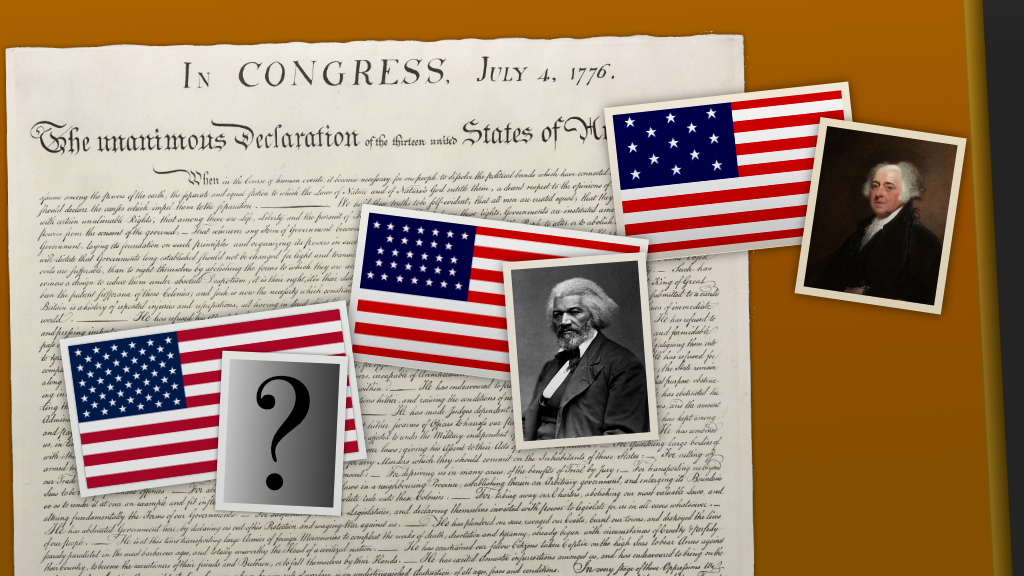
In 17 days, the draft of a ‘Declaration of Independence’ was done and was presented to the Congress on June 28th. With amendments (among others, removing concerns about slavery), it was adopted on July 2nd , 1776. A formal copy was prepared which was officially signed July 4. Notably, the Congress’s presiding officer John Hancock of Massachusetts signed his name extra large so that “King George could read it without his spectacles.”
As the last line of the “Declaration” makes clear, the Delegates in pledging “… their lives, their fortunes, and their sacred honor ...” knew they were taking a big step. Their action clearly constituted ‘treason’ against the crown, a hanging offense. If the movement failed, they would lose everything; their lives, their liberties, and property, not to mention their pursuit of happiness. Nonetheless, they took that step, signed the document, had copies made to be sent to every colony, and of course, to the King. It was read with varying interest over the next month as news arrived. It was read in Boston, for example, on July 18th, and in Savannah, Georgia, on August 10th.
By the mid-1780s, after the Revolution was done, veterans of the 2nd Continental Congress began to propose that the Declaration should be celebrated annually. Many proposed July 2nd as ‘Independence” day, the date the declaration was adopted. By peculiar coincidence, both Thomas Jefferson and John Adams died on July 4th, 1826, exactly 50 years after the signing. Unofficially, July 4th, became the occasion to celebrate. However, there was no agreement about how to observe or what to note. Many communities had work holidays, parades, feasts, military performances, and fireworks. Some leaned more heavily on oratory and prayer.
In 1854, abolition advocate and escaped slave Frederick Douglass wrote a damning essay entitled, “What to the slave is the 4th of July?” Less than a decade later, half of the nation seceded to form the Confederacy, challenging as never before the idea of an independent United States of America. That great civil war and its aftermath formalized both the 4th of July and Thanksgiving as national patriotic events; one of raucous celebration, one of solemn gratefulness.
Now, at 250 years, ten generations from July 4th, 1776, we again ask ourselves, “What is this 4th of July hoo-hah about?” Should we celebrate our national ‘greatness’? Our global imperial influence? Our awesome military power? Our advanced technology? Our cultural impact? Coca Cola? Should we extol our role as a beacon of liberty and opportunity to the world? Should we celebrate how far we’ve come toward realizing the Declaration’s assertion of ‘unalienable rights [to] life, liberty, and the pursuit of happiness’? Or, should we acknowledge how far short we have fallen in our struggle to realize those goals?
I believe that the great lesson of the Declaration of Independence is that both freedom and the struggle to achieve it are hard and risky tasks. “… life, liberty, and the pursuit of happiness …’ might be asserted as divinely given rights, but it takes courage, vision, struggle and sacrifice to create even the merest semblance of those blessings.
In our time, as in every age, there are those who believe that all good things are theirs for the taking. They may dress up their greed and corruption in high flowered words. They may rally others to support their power with promises of sugarplums for everyone down the road. They will demonize those (of us) who prefer to live in a society that cares for the sick and the needy, welcomes the stranger, shares our bounty, and creates opportunities for all. We cannot hope that these good things will come of their own volition. We have to make those things happen. We have to create the structures to do those things we cannot do as individuals, and yet leave the spaces for innovation and adaption. We have to accept our imperfections, always hoping others will take up the problems we cannot solve. We have to accept that we may be singled out, attacked, denounced and penalized for opposing oppression.
On July 4th, 1776, a few foolishly hopeful brave delegates signed their name to this notion; that freedom was worth struggling for; worth fighting for, work risking everything for. As wealthy property owners did they have a belief that their gamble might pay off for them? Likely. Could they be sure? Certainly not.
This year, we celebrate that they took that great chance. We celebrate those who have taken the same risk in every generation since to bring us to this 250th anniversary. We hope that we too have the courage and vision to meet the challenges of our age. Can we be sure we are right? No. Can we be sure we will win? No. Can we draw on the courage of those 56 flawed men and their successors for inspiration? Yes. And that is what the 4th of July is about.