

Grave markers and cenotaphs conceal as much as they reveal about the soldiers who fought and died in our nation’s wars. Each day as I walked to work, living in central Massachusetts, I would pass by memorials to the living and the fallen. At the very center of the Worcester Common, for example, there’s a monument to Colonel Timothy Bigelow, a local blacksmith who led this town’s contingent of Minutemen at Lexington and Concord, fought at Saratoga and camped at Valley Forge, joined in the assault on Quebec, but returned home sick and exhausted when the fighting was done to find his business in disarray and his property gone. Facing post-war inflation and unable to make ends meet, the Revolutionary War survivor was thrown into jail and died in debtors’ prison at the age of 51. Like many modern day vets who find themselves homeless or unemployed, he was a different kind of war casualty.
Nearby Bigelow’s spire is a memorial for the Civil War, with a winged angel of victory on top and a plaque honoring the 398 men of Worcester who perished in that conflict. Among the thousands of others the state sent south there was Amos Jackson, an African American who fought with the 5th Massachusetts Calvary. A letter he wrote home to his friend Dolly Hazzard has been preserved from 1865. There the soldier apologizes that he doesn’t have more news of the war, and guesses that Dolly probably knows more about it than he does if she reads the papers. He’s stationed on duty at Point Lookout, Maryland, a prison camp holding Confederate POWs, and he writes of a wet, dreary winter, with the ice on the river an inch and half thick, sharing rations with his friends but still with enough to eat. “We are all well thank God,” he says, yet the message sounds forlorn: “I would like to come home and see you all once more … Write me soon pleas and tell me how you and all the folks at home get alonge.” Amos was one homesick soldier who made it back alive.
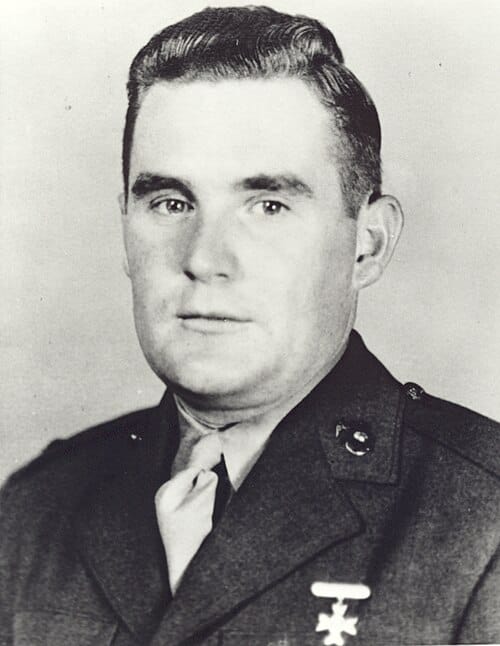
Heroes come in all shapes and sizes: farriers and farmers, black and white. Most probably don’t consider themselves heroes at all, like Medal of Honor winner John Vincent Power whose statue is on the south side of Worcester’s City Hall and who was heard to remark to a shipmate on the way to the Marshall Islands in the Pacific that he intended to let someone else have the glory. What soldiers are, most of them, are ordinary people put into unordinary circumstances: weeks of mud, tedium, institutional food and military regimentation punctuated by moments of sheer panic that push men to extremes where they find themselves doing extraordinary things like Lieutenant Power, crawling badly wounded toward a pillbox to save his buddy’s lives, nothing that his math classes or the mandatory chapel at Holy Cross could possibly have prepared him for.
Back in the sixties, folksinger Buffy Sainte Marie wrote a tune titled “The Universal Soldier,” where she sang:
He’s 5 foot 2 and he’s 6 feet 4
He fights with missiles and with spears
He's all of 31 and he's only 17
He's been a soldier for a thousand years
The point is, they’re all different and all the same. Some join the armed forces out of idealism, others are drafted. Some go to the recruiting office out of economic necessity or attend military academy because it’s a family tradition. Some die at enemy hands, others from friendly fire, while a few fall into the pit of suicide. But almost all were far too young, cut short before their time. So on this Memorial Day weekend, we honor them all, every man and woman who has served and sacrificed wearing their country's uniform. We remember the widows and the orphans they left behind, the Gold Star mothers and grieving fathers. The casualties of the country’s wars number 1,308,468 in all, with more added in the frequent headlines, like the thirteen Americans killed in the conflict with Iran, so that if we paused now to give each G.I. just one second of silence we would be sitting wordlessly for more than two weeks, faced with wall as dark and inexpressible as the Vietnam memorial in Washington, D.C., one of the few war monuments that both those who protested and those who enlisted seem to find honest and healing, as a vet named Bob Gura writes in a piece simply titled “The Wall”:
There is honor here without glory,
there is sorrow without anger
there is a past here that should not be forgotten
there is a future that never was
Some may shed a tear this Memorial Day. Others may place flags or flowers upon a grave. But such caring gestures would mean little unless we asked the question of what we, the living, owe to the dead. Surely more than speeches. More than Memorial Day sales or picnic recipes. We owe them solemn thanks. We owe those maimed and injured or traumatized rehabilitation and re-entry to a normal life. We owe respect to the military commanders who, far more than elected politicians, seem reluctant to commit forces to combat, knowing how much can go wrong in the pandemonium of battle.
But more than that, I think we owe them a promise that we will never allow this nation to again go to war needlessly. That the preemptive wars, the bully little wars, the proxy wars will not be countenanced without people of conscience speaking out, so that (in the words of John Kerry) no man will ever again be asked to die for a mistake. We owe them a pledge to take the profit out of warfare to guarantee that one man’s loss is never the cause of another man’s gain. We have an obligation to rein in what one West Point graduate called “the military-industrial complex,” what this five-star general identified as a “permanent armaments industry” that in his words “makes itself felt in every city, in every state house, in every office of the federal government.” We need an honest accounting, so that if some Americans are asked to pay with their lives, other Americans will have to pay in the form of higher taxes and not foot the bill for war on the credit card, passing on the burden of debt to our kids. We owe them shared sacrifice, not bone spurs or excuses. Like them, we need to be ready to live out our patriotism and not just advertise it on a bumpersticker or with a flag on our lapel.
My wife’s parents are both in Arlington National Cemetery, buried with gun salutes and bugles playing taps. My father-in-law was a navigator during World War II, dropping bombs on Japan, days he described as among the best of his life. Yet he was sensible by the time he retired from the Pentagon that the arms race had become a blind alley. He might not have approved of all their methods, but I think he probably would have supported most of the stated goals of Veterans for Peace:
To increase public awareness of the costs of war
To restrain our government from intervening, overtly and covertly, in the internal affairs of other nations
To end the arms race and to reduce and eventually eliminate nuclear weapons
To seek justice for veterans and victims of war, and
To abolish war as an instrument of national policy.
Working for peace is what we the living owe the brave women and men who gave their lives, to make the statues and memorial markers and marble columns unnecessary. To let the cannons on the town squares of America turn to rust. To put the buglers out of business. Not to forget Bunker Hill or Spotsylvania, or the Western Front or Normandy, or Da Nang or Falujah, but to put those battlefields in the past as we imagine another kind of field.
A field, in the words of the poet and World War Two vet William Stafford:
Where the battle did not happen,
Where the unknown soldier did not die.
[A field] where grass joined hands,
no monument stands,
And the only heroic thing is the sky.
No people killed—or were killed—on this ground
Hallowed by neglect and an air so tame
That people celebrate it by forgetting its name.