
What is democracy? Does it mean wearing a campaign button or voting, running for Congress or maybe running against Congress, pledging allegiance or kneeling for the national anthem or carrying a protest sign? Swearing in a new governor, or maybe swearing at a new governor? Democracy can mean all those things. But to really understand it, it helps to have a little history.
Back in the day when my mother was young, the President of our country was Franklin Delano Roosevelt. Probably before your time. But in those days, the world was in big trouble.
Here at home, factories were closing. People had no jobs. Millions had lost their homes. Banks were going bust. Overseas, the Nazis had invaded Czechoslovakia and overrun France. Japan had troops occupying China. Bullies and dictators with big armies were rattling their bayonets.
And in this climate of chaos and fear, President Roosevelt gave a speech to remind Americans of the bedrock values on which our nation was founded, values that he said would have to become worldwide for the human race to find security and peace. It became known as the Four Freedoms speech. Freedom of speech, freedom of worship, freedom from want, freedom from fear: these were the doors to a safe and hopeful tomorrow, the President said.
Two years later, an artist named Norman Rockwell put flesh-and-blood on the President’s words with a series of paintings that showed what democracy meant in the lives of ordinary men and women. If you visit the Norman Rockwell museum in Stockbridge, Massachusetts, you can see the original artworks. The Four Freedoms are big paintings, so large you can almost step inside and feel part of the story.
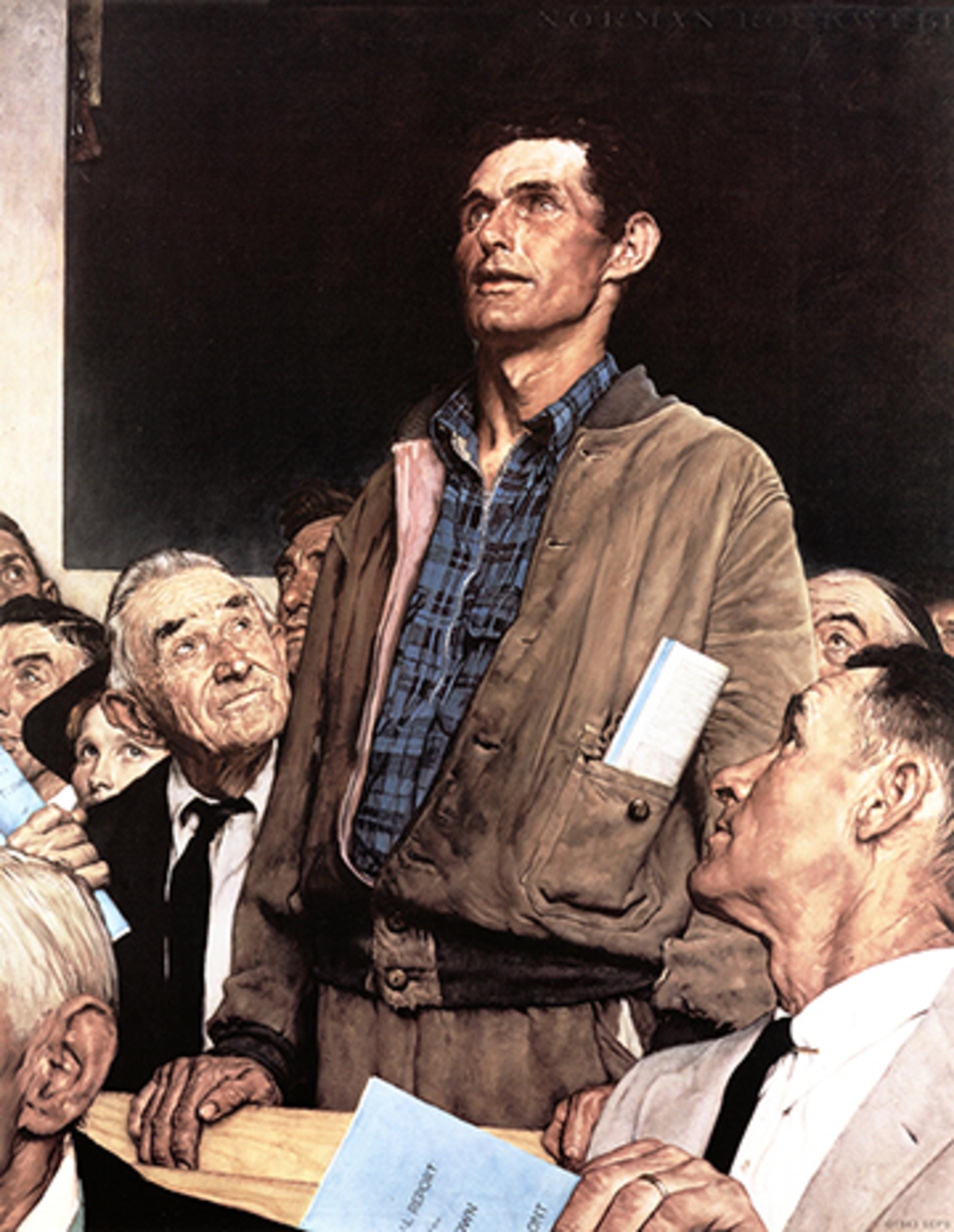
The first is Freedom of Speech. A man lifts his voice at town meeting. From his complexion and weathered hands, he probably works outdoors for a living. Two men nearby in jackets and ties are sitting down, looking upward toward the speaker whose blue plaid work shirt is open at the collar. The speaker seems sure of himself and sure of his words, obviously respected by his better dressed neighbors, who pay more attention to what the man’s saying than to the cut of his clothes.
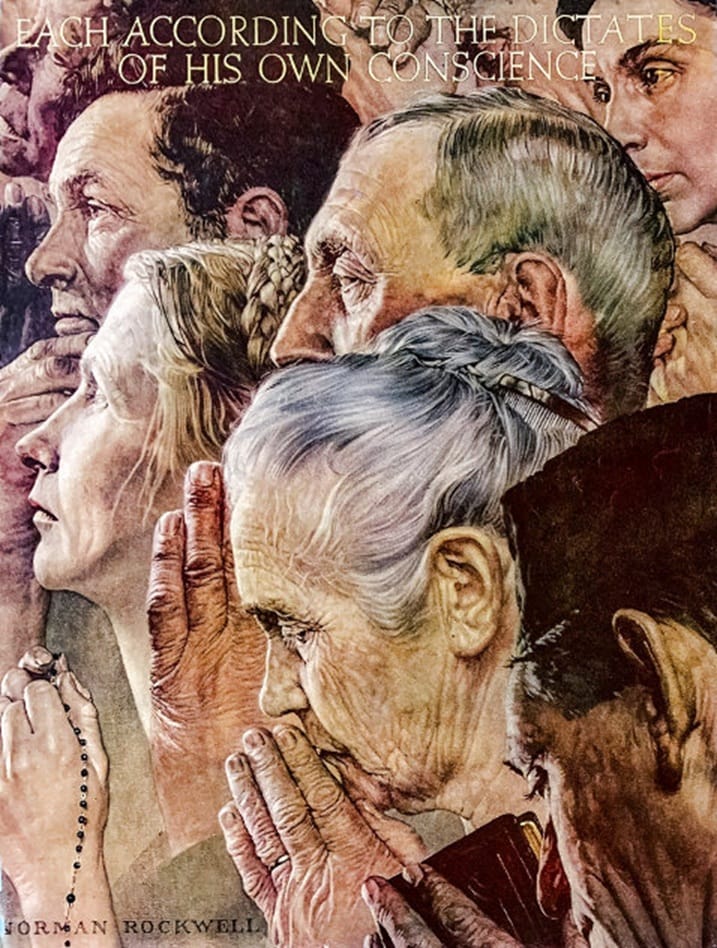
The second is Freedom of Worship. The canvass is filled with women’s and men’s faces, bathed in soft, warm light, hands clutched or gently folded in prayer, one holding the prayer beads of a rosary, people of all races whose eyes seem full of cares and burdens but which are all focused on something invisible that we can’t see, out beyond the frame of the picture. Across the top of the painting are the words of James Madison, father of the U.S. Constitution, “according to the dictates of conscience.”
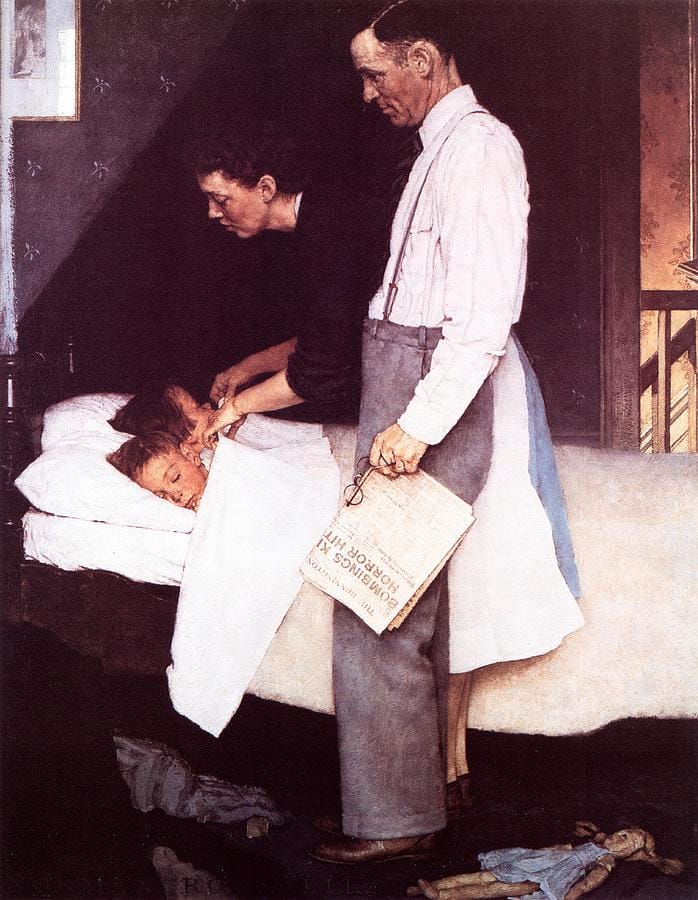
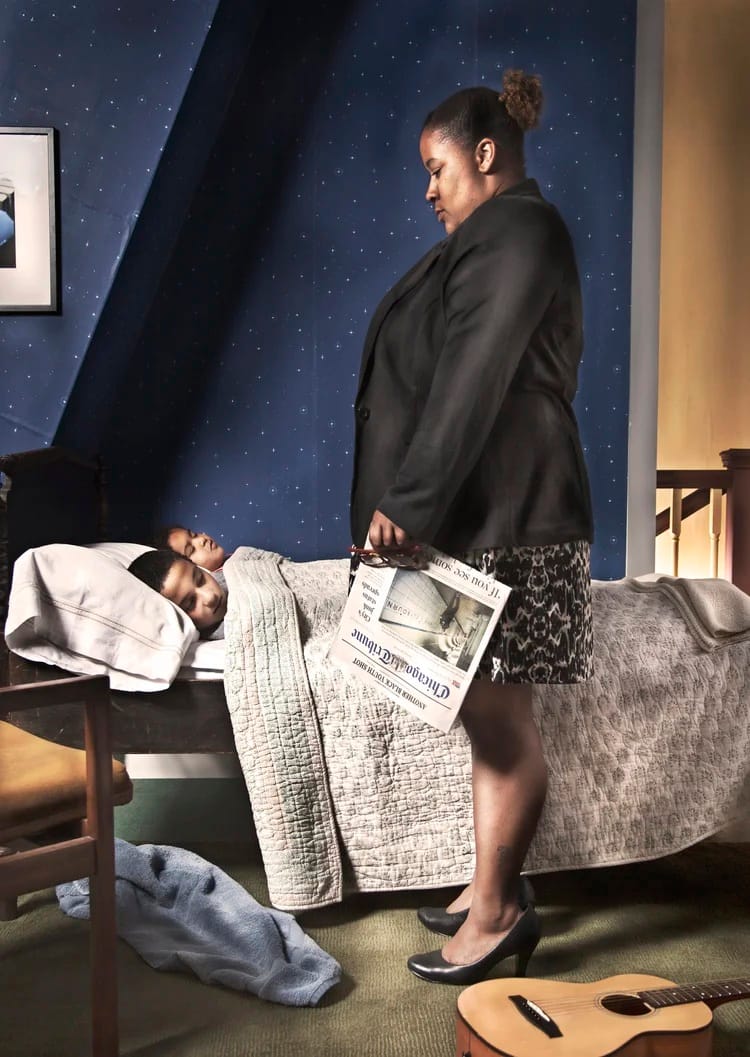
Freedom from Fear, the third painting: Two young children are being tucked into bed by their mother, bending down with infinite tenderness, as father stands by her side gazing at the sleeping youngsters, the father weary but proud and protective, holding in his left hand a folded newspaper whose headline is only partially visible, but speaks of horrors overseas, “Bombings kill.”
Freedom from Want: the viewer seems to be welcomed into this final picture in the series, to become a guest at a traditional Thanksgiving Dinner with all the trimmings—turkey, mashed potatoes, cranberry sauce—sharing the abundance of one family’s celebration of this most typical of American holidays.
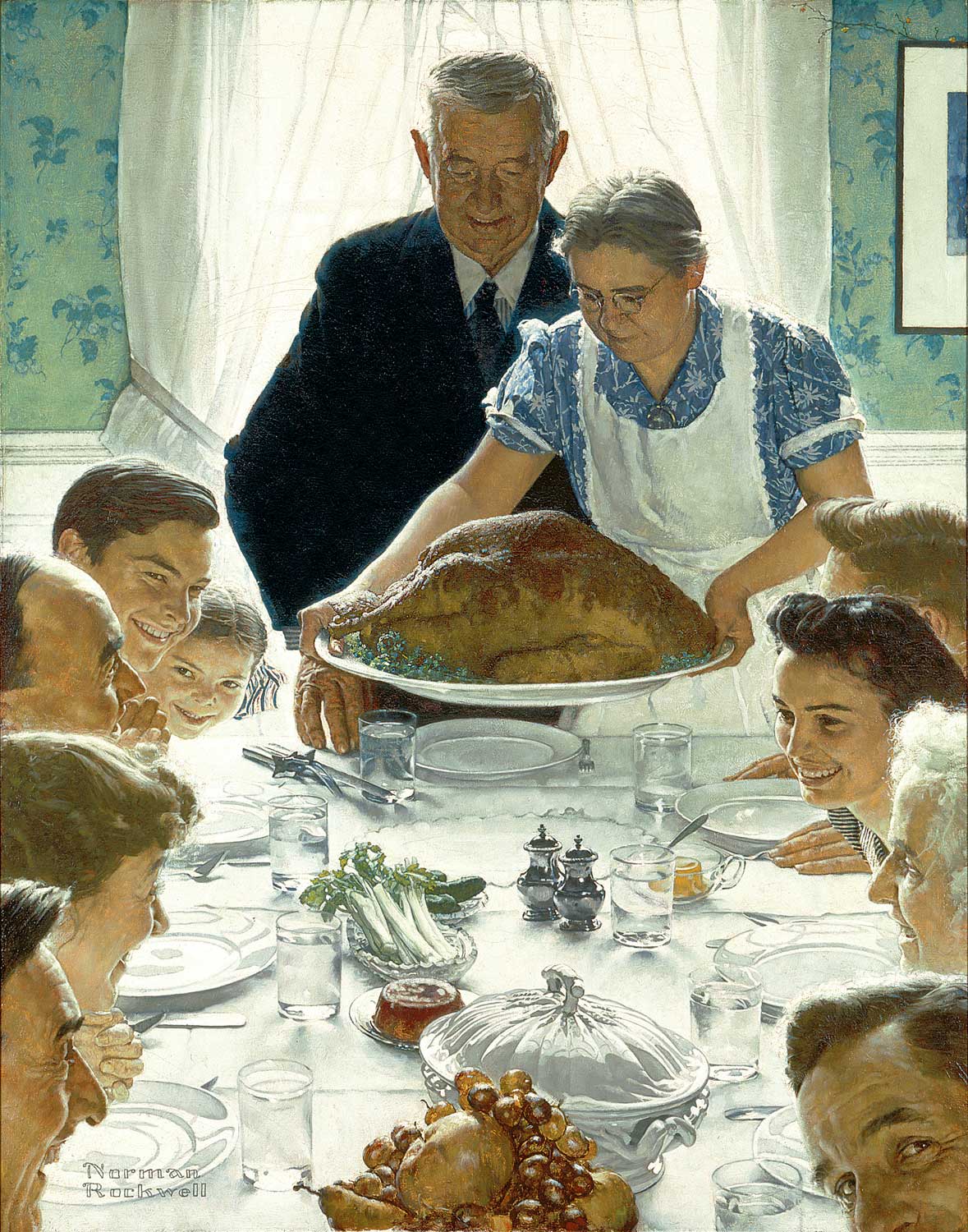
These Four Freedoms, as enunciated by Roosevelt and depicted by Norman Rockwell, are close to being the touchstones of our democratic tradition. After all, the Pilgrims who celebrated that first Thanksgiving also organized the original New England town meetings, where people still take direct charge of the decisions that affect their lives in matters large and small, a style of grassroots decision making that Thomas Jefferson called "the wisest invention ever devised by the wit of men for the perfect exercise of self-government, and for its preservation."
Freedom from Fear: saying “no” to violence as the way to resolve our disputes. Freedom from Want: building a world where everyone has a seat at the table. Freedom of worship: where Muslims, Jews, Buddhists and Christians can live as friends. Freedom of Speech: where open debate and honest questions will always be welcome. The world has changed dramatically since my mom was young. Yet these Four Freedoms are like a roadmap to keep us on the path.
Rockwell’s paintings went on international tour a few years back, on the anniversary of their creation. They passed through seven U.S. cities and Normandy, France, for D-Day, before returning home. And as part of the celebration, the Rockwell Museum and Foundation invited other artists to create their own 21st century renderings of these classic images which, after all, do need updating.
To his credit, Norman Rockwell possessed a deeply moral imagination. While his work raised tens of millions of dollars in war bonds to fight the Axis, he never glorified combat or depicted scenes of victory on the battlefield. No, instead he chose to celebrate the mashed potatoes, the little children sleeping. But the models he chose were most often his own neighbors from the postcard town of Manchester, Vermont, where he had his studio and home, and couldn’t reflect the full diversity of the America he loved. So he quit the Saturday Evening Post when they refused to let him paint African Americans in anything but menial positions and went to work for a new magazine, Look, where he immortalized new images like brave Ruby Bridges, walking to school at the age of six in Little Rock, Arkansas, after the Supreme Court declared an end to “separate but equal” in public education, surrounded by federal marshals.
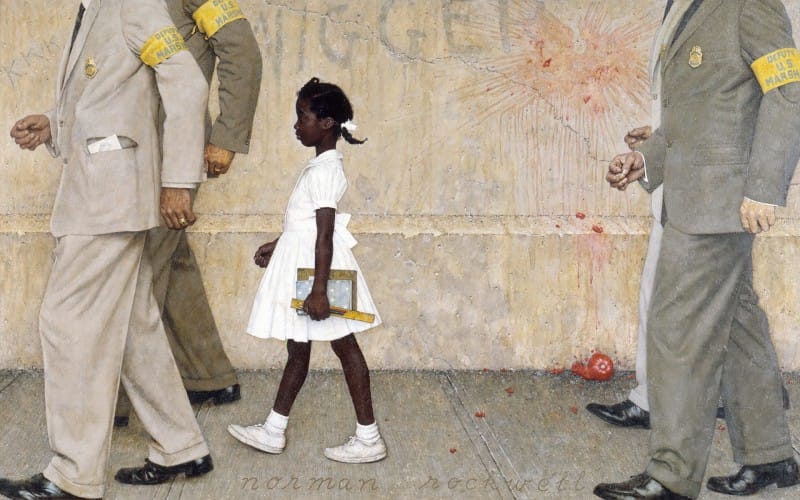
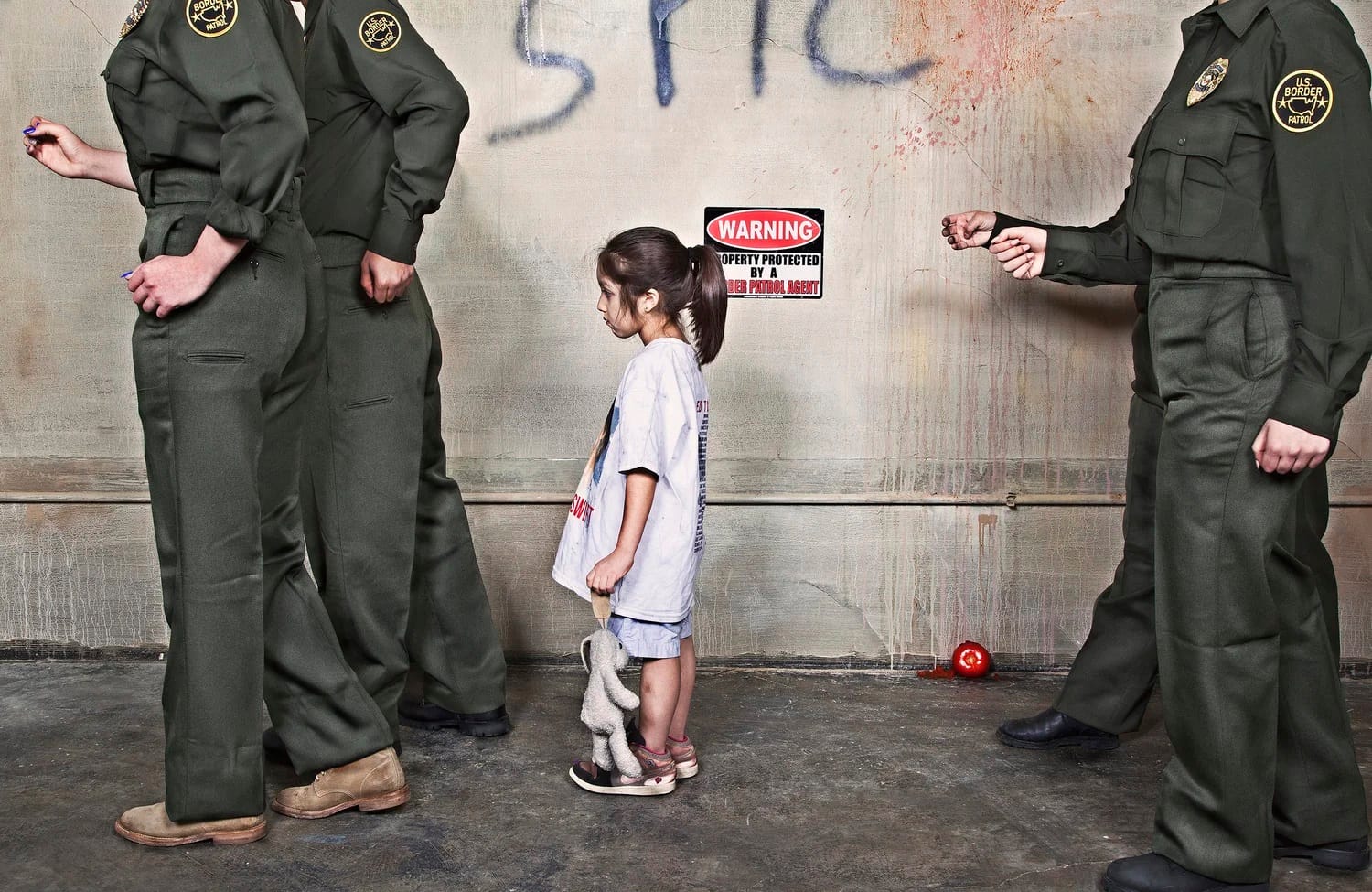
A smashed tomato, hurled against a wall bearing a scrawled racial epithet forms the backdrop for his painting The Problem We All Live With. Rockwell was evolving in his consciousness, just as the country was evolving. And I think he would have approved of the new artworks which are in his style.
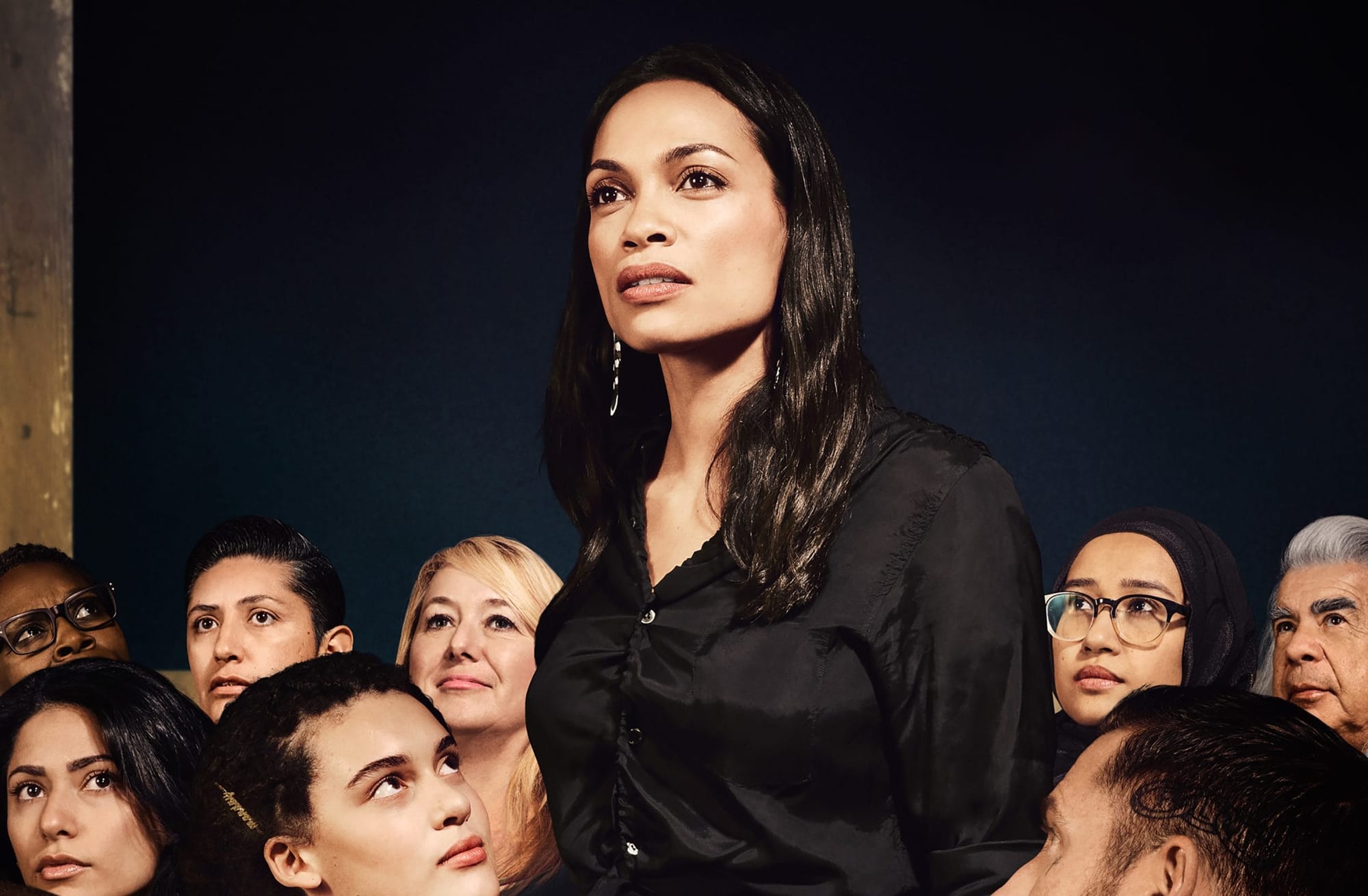
Actress Rosario Dawson, of Cuban and Puerto Rican ancestry, posed to exemplify Freedom of Speech. One senses that in this community meeting, women have a voice and se habla espanol.
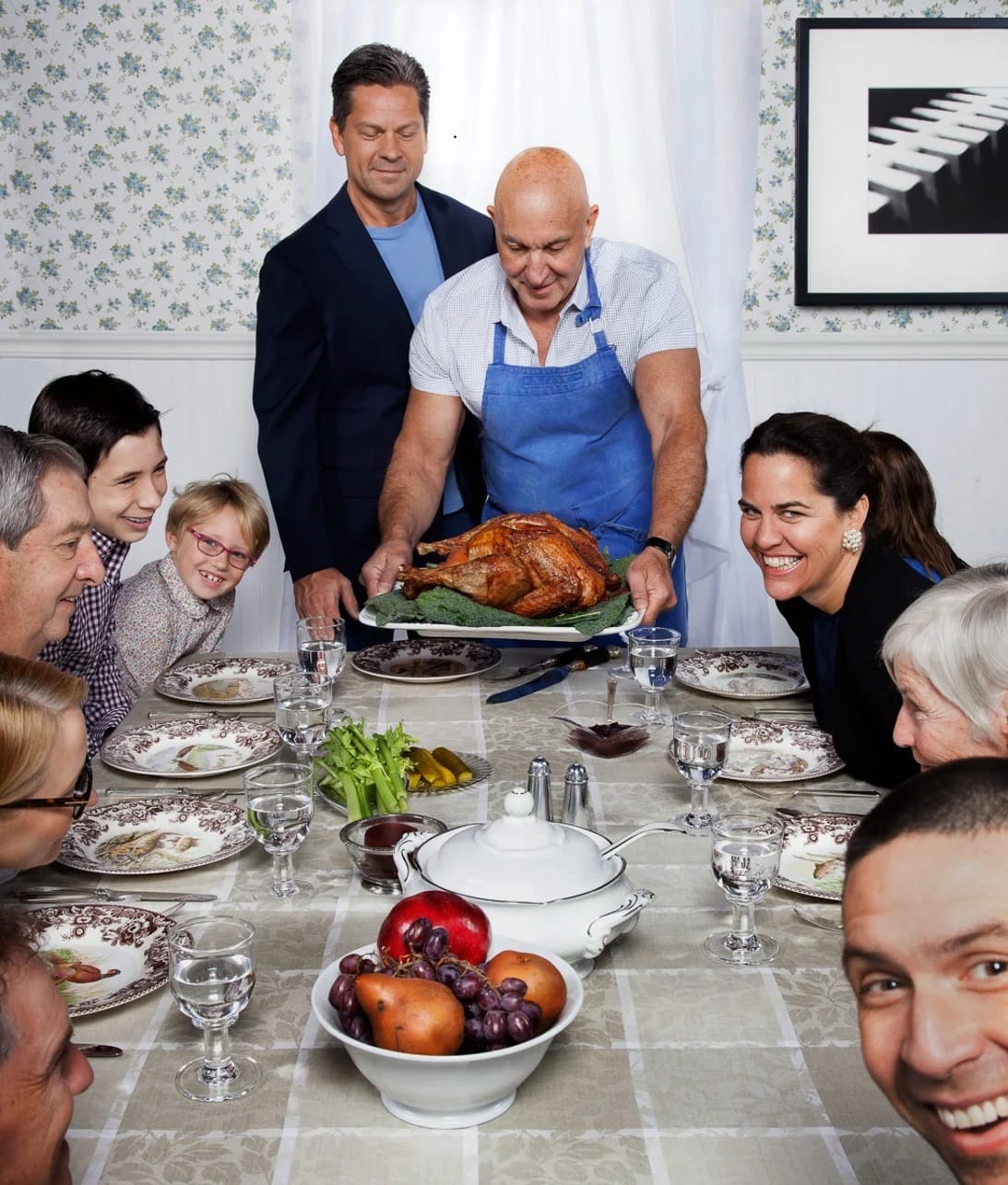
Shortly after California legalized same sex unions, artist Maggie Meiners asked her friends, two married gay men, to take the role of gram and gramps at the head of the table serving up the traditional turkey roast. Grandparents never looked so buff.
The same artist, in her Revisiting Rockwell series, modified Freedom from Fear to show an African American mom tucking her kids to bed, even as she grasps a copy of the Chicago Tribune with the headline “Another Black Youth Shot.” Black lives matter.
And when a muslim man spoke at her church, she captured his image, too, along with a woman wearing a traditional headscarf or hajib, a copy of the Qu’ran replacing the rosary in Rockwell’s original version.
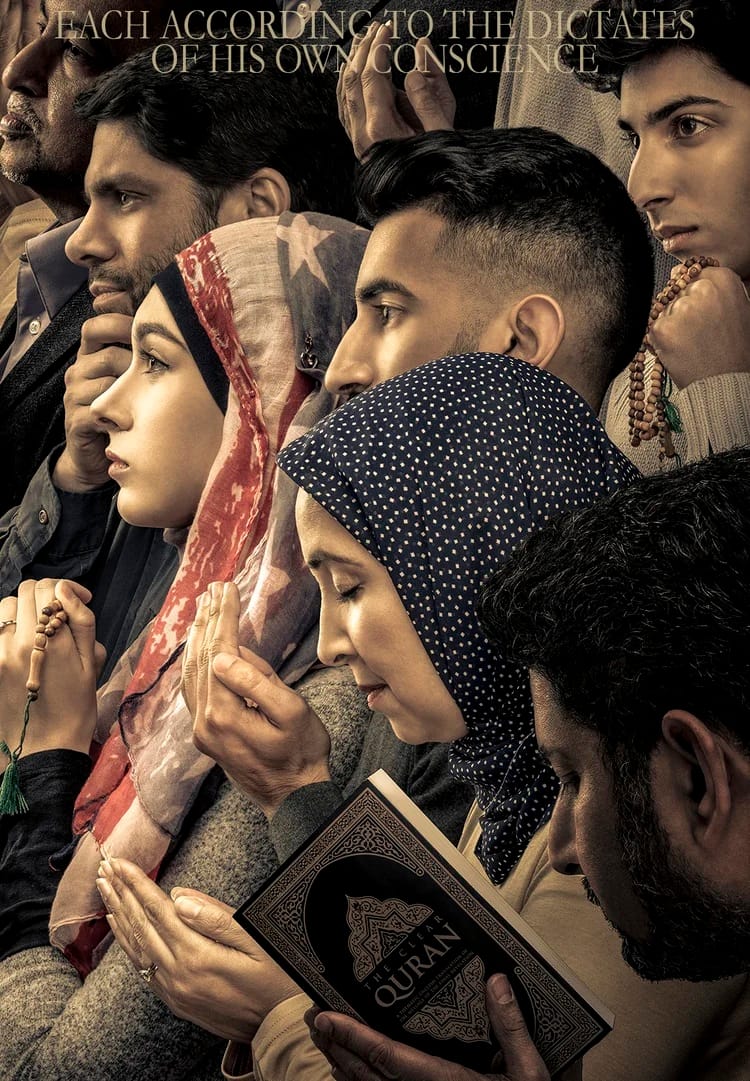
No, not replacing the rosary or the Bible or Rockwell's other iconic symbols. Rather, adding to. Expanding. Broadening. Because what these new artworks say is that Normal Rockwell’s America isn’t dead. What they’re saying is that this is what America now looks like. This is what the Four Freedoms look like. The forms of liberty aren’t just museum pieces or relics of a bygone age. They’re living, growing, vibrant realities, although constantly in danger of being lost or corrupted.
America has almost forgotten the Great Depression and become the world’s richest nation yet remains in danger of moral bankruptcy as the poor are left behind. America is no longer threatened by armies from abroad, having achieved the military might to destroy the earth many times over, yet in the arrogance of power risks creating endless enemies and perpetual war. Having defeated the Nazis in Europe, we find them in high office and marching in our own backyard. The country at times seems to have lost its sense of direction. But for that very reason, I believe that democracy matters. People assembled to discuss the issues of the day, to pool their resources for the common good and vote on how their money gets spent, electing their own town moderators and school boards, exercising the faculty of dissent, learning how to disagree with each other without being disagreeable, practicing tolerance—all of this matters enormously if the Four Freedom are to be kept alive.
Because democracy isn’t something that happens far away, in Washington D.C. or on the evening news. It starts right here, with us, in our homes and mosques and synagogues, in our town halls and local elections. Interfaith, multiracial, bilingual, and vari-colored: We are what democracy looks like.