

Between now and now, between I am and you are, the word bridge. Entering it you enter yourself: the world connects and closes like a ring. From one bank to another, here is always a body stretched: a rainbow. I'll sleep beneath its arches.
So says the Mexican poet Octavio Paz. If you pass from his nation to the United States, or vice versa from north to south, you may cross the Juarez-Lincoln Bridge. Two countries and two great names linked by a span of concrete and steel but also by time, conflict, culture, and history. All worth remembering on this holiday of Cinco de Mayo.
Why remember Cinco de Mayo? Maybe because of William Faulkner’s quote that “The past is never dead. It’s not even past.” Maybe because of the phrase, “die unvollständige Vergangenheit,” the unfinished past, which Germans use to describe their complicated relationship to the bloody history they do not deny, but instead try to compensate and atone for, whose atrocities continue to reverberate to this day. Maybe because our own country has just re-entered a dialogue over paying reparations for slavery, the “peculiar institution” which officially ended on the first day of the year of 1863 with Lincoln’s Emancipation Proclamation, one hundred fifty six years ago, but whose effects still linger in terrible disparities of income, wealth, and opportunity. Maybe because that same Proclamation to end slavery took place just a few months after a battle that occurred in the small Mexican village of la Puebla on May the Fifth, 1862, where a royal descendant of King Ferdinand and Queen Isabella (of Columbus fame) lost the field and yielded hopes of restoring a king to the throne of Mexico, helping to insure Lincoln’s victory. Maybe because just last month, the people of Majorca (a semi-autonomous province of Spain and lovely island for tourism situated just a couple hundred miles off the Iberian peninsula) held a straw poll on abolishing the institution of the Spanish monarchy entirely as a pestilence and drain on the local treasury. The vote was overwhelmingly anti-royalist. Maybe because hundreds of mascogos, which is to say North Americans of African descent who escaped slavery in Texas to find freedom south of the border six generations ago are now seeking repatriation and asylum in the United States, their former homeland, where their U.S.-born ancestors were regarded as chattel to be traded and sold at auction. Maybe because Fox News recently ran a headline, “Trump Cuts Aid To Three Mexican Countries.” Maybe because dumb, dumber and dumbest shouldn’t be our only options. Maybe because learning geography and history are complicated, but still very vital to understanding how we got where we are now.
Between now and now, between I am and you are, the word bridge.
Or as the Spanish poet Jose Moreno Villa wrote, “History endures in Mexico. No one has died there, despite the killings and the executions. They are alive—Cauauhtémoc, Cortés, Maxmilian, Don Porfirio, and all the conquerors and all the conquered. That is Mexico’s special property. The whole past is a pulsing present. It has not gone by, it has stopped in its tracks.”
Celebrating a seemingly Mexican holiday isn’t a case of cultural misappropriation. In fact, Cinco de Mayo has always been a holiday more important north of Rio Grande. It started in southern California as far back as 1863, where Mexican American miners shot off fireworks and rifles to mark the anniversary of the la Puebla victory. Four thousand rag tag mexicanos overcoming a trained French battalion twice their size! Imagine. Of course, southern California had been part of Mexico until 1848. Californians then were Mexicans, by and large. Or as I saw it expressed on a baseball cap at a rally on the plaza not long ago: Make America Mexico Again. At that time, Congressman Abe Lincoln of Illinois had been one of the few dissenting voices in Washington to oppose the Treaty of Hidalgo-Guadalupe which bought up Texas, New Mexico, Arizona, California, Colorado and parts of Wyoming for what’s now at least twice the cost of a nice home in the Las Campanas neighborhood of Santa Fe. Fifteen million dollars. The Mexican-American War, after all, had been a pretext for extending slavery, and Lincoln wouldn’t have it. But then, like Mother’s Day or Valentines, or other manufactured hocum, Cinco de Mayo spread quickly to other parts of the country with heavy advertising from the beer industry. Patriotism, cerveza, and Latino pride became a commercial gimmick. Yet we owe it to our ancestros, nuestros anteredores, to dig deeper.
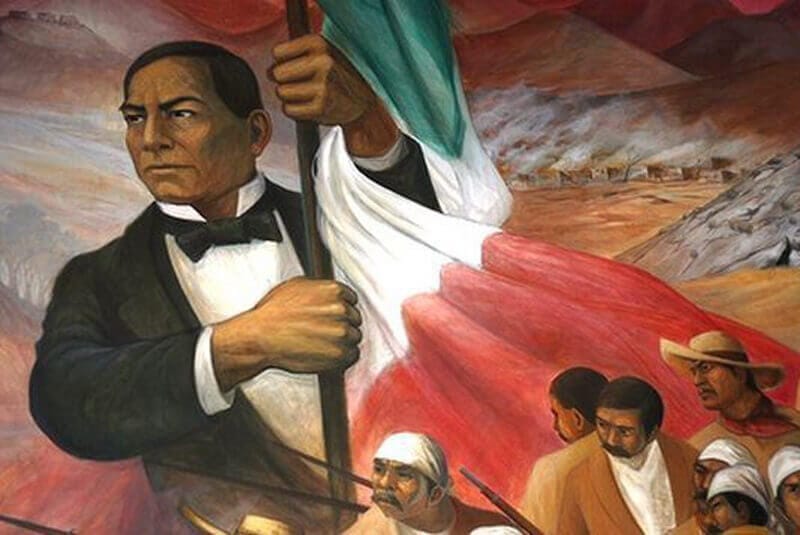
News travelled more slowly in those days before the internet. On May 11, 1865, Benito Juarez, the President of Mexico, wrote to U.S. Secretary of State William Seward from Chihuahua expressing his condolences for events that had occurred more than a month before, in April. Congratulations that the Confederacy had been unconditionally defeated; Lee had surrendered to Grant at Appomattox; plus deep regrets that Mister Lincoln “who had worked with so much earnestness and abnegation for the cause of freedom” had been assassinated. Juarez and Lincoln never met but shared many bonds. Each had lost parents at an early age. Each had advanced their fortunes by marrying into wealth. Each had a reputation for absolute probity and incorruptible character. Both were lawyers and each dedicated to the rule of fairness and due process over personal profit or privilege. Each shared humble though disparate origins: Juarez a full blooded Zapotec Indian born in a bamboo hut, Lincoln a child log cabin-born who later became an Indian fighter. And it would be fair to say, historically, each became the father of their nation, and of their nation’s best hopes for unity and peace.
Before the American Civil War, realize, the United States was more a collection of provinces or former colonies than a genuine nation. Like Robert E. Lee, who attended West Point but felt greater allegiance to Virginia than to any legally constituted government in Washington, many Americans identified primarily as Georgians, or Bostonians, with regional loyalties that were stronger than any sense of national purpose. Mexico likewise, though it had declared independence from Spain in 1810, still included dozens of tribes and languages as well as caste distinctions between the peninsulares born in Spain, the creoles of hispanic heritage but born in the New World, and the mestizos of mixed race as well as indigenas. There was no nation of Mexico in any modern sense. It was a land still struggling to escape from a feudal, theocratic and colonial past.
The Constitution of 1857 changed that. It established freedom of speech, freedom of association and freedom of religion. It re-affirmed the abolition of slavery, ended debtor’s prison, provided a right to free legal counsel for those accused of crime and eliminated the death penalty. It guaranteed the right to bear arms and did away with titles of nobility, offering every citizen equal protection under the law. It also reined in the power of the Roman Catholic Church, not entirely, but enough to spark outrage among religious and political conservatives, igniting what became Mexico’s own civil war, the so-called War of Reform.
Melchor Ocampo was the firebrand of that reform. His contempt of the church began the day he witnessed a poor campesino begging the local priest to offer his dead son a Christian burial, but had no money to pay the customary fee-for-service. When the priest refused, the poor man asked what he should do with his child’s body. “Salt it and eat it,!” the priest answered coldly. Ocampo realized then how the Church and wealthy elites held believers in bondage. Peasants borrowed money from the landowners to pay for weddings, burials, prayers and baptisms, money they could never repay at exorbitant interest. The workers became debt slaves, in effect. In Mexico, the phrase for the process was endrogarse, “to become addicted.” Las drogas. Once addicted, the peons could be bartered, traded, inherited and sold like cattle; they belonged like property to the owners of the great haciendas.
And so the battle began between the Old Guard and the young liberals. Most of these so-called liberals were more moderate than Ocampo; in fact they called themselves moderados and would have preferred a peaceful co-existence with Catholicism, curtailing only the worst abuses. But tensions rose when reactionary armies slaughtered the entire village of Tacubaya, soldiers, civilians and even the nurses caring for the wounded. Church dignitaries organized a grand celebration for the occasion. After more stinging defeats, the liberals rallied forces and installed Benito Juarez as President in the capital of Mexico City in January of 1861, the same month Lincoln was inaugurated President of the United States. But Mexico remained as divided and wartorn as its neighbor to the north. Ocampo was dragged from his home by right wing vigilantes, shot and hanged. Inflamed, the previously moderate reformers began to smash church altars with axes, burning convents, stoning bishops. And then things got weird. Weird and ugly.
Ferdinand Maximilian Joseph von Habsburg was born in Vienna, having the bad luck to be second in line to his older brother Franz Joseph, the King of the Austro-Hungarian Empire. Max was distantly related to most of the royalty of Europe in ways that only those of you who have been watching Victoria on PBS can really imagine, in addition to being a distant but direct descendant of those most Catholic monarchs who started the Inquisition and drove the Jews from Spain in 1492. Maximilian was of a different stamp, for the most part an enlightened and tolerant, somewhat dreamy young man, but he was also a king without a kingdom. So when a coterie of clerics and caudillos (that’s a Spanish word for big shots) connived to invite Max to become the Emperor of Mexico, with French bayonets, to back him up, it seemed to be a win-win for everyone. The Church would have a Catholic on the throne to protect their grip on power. Napoleon the Third would re-establish the military stronghold in North America that Napoleon the First had so foolishly squandered when he sold the Louisiana Purchase to Thomas Jefferson. And Maximilian? He and his queen Carlota would become wise and beloved sovereigns embraced by the Mexican people for their benevolent reign.
But Mexico already had a wise and benevolent, legally legitimate leader—Benito Juarez—so none of it worked out. Outgunned by the French, Juarez and his army retreated north to Chihuahua, but not before beating them badly at Puebla on Cinco de Mayo. The win probably got more press in Philadelphia than in nearby Veracruz, because the North had already lost Fort Sumter and the First Battle of Bull Run. Lincoln’s men were taking a drubbing. The Armies of the Republic needed a shot in the arm to boost morale. Some of you may have visited the battleground at Glorieta Pass, here in New Mexico, which is sometimes called “the Gettsyburg of the West.” But Puebla, fought about the same time, probably deserves the title even more. France clearly had its sights on California’s gold and Colorado’s silver. Jefferson Davis’ delegate to Paris promised that in exchange for recognizing the Confederate States of America and helping break the naval blockade of Charleston and other southern ports, France would get raw cotton in return. And if Juarez hadn’t finally prevailed, New Mexico could well be a slave state today. But the French finally realized they were fighting a losing cause, throwing good money after bad, and withdrew their troops. After Appomattox Court House, a few die-hard Dixie regiments refused to surrender and headed south to offer their services to Maximilian. Max welcomed them, saying they could keep their slaves as long as they were called indentured servants, or something along those lines. (Wink-wink, nod-nod.) But by that time, the fight was nearly over in Mexico. The would be Emperor Maximilian was hunted down, given a fair trial, and shot. But like Lincoln, Juarez offered an olive branch to his countrymen who had taken arms against him. “With malice toward none, with charity for all,” was how Father Abraham put it. The father of his country, Benito Juarez said it this way:
Neither in the past nor much less in the hour of total triumph for the Republic, has the government desired—nor should it desire—to be moved by any feeling of passion against those with whom it waged war … We shall now put all our energy into obtaining and consolidating the benefits of peace … Let the people and the government respect the rights of all, because among individuals, as among nations, peace is respect for the rights of others.
Over time, Juarez lost the faith of his youth. He was no longer one of the moderados, but had come over to Ocampo’s way of freethinking. During the darkest years of his war with the French, he had written to his wife, far away in the safety of New York, to oversee the instruction of their children. “I beg you not to put them into the hands of a Jesuit or a minister of any other religion; they should learn to philosophize, that is, they should learn to investigate the why or the reason of things, so that, during their passage through this world, they may take the truth for their guide and not errors and prejudices that sadden and degrade men and nations.” His reverence was no longer for dogma, tradition or the Virgin; his devotion was for liberty, the Constitution and its ultimate source, the will of the people.
So enjoy a cerveza today: Negra Modela, Dos Equis, Corona, or Pacifico. After all, it’s a free country, so you choose. But know why you’re drinking, and for whom. A Mexican holiday. An American holiday. A deeply democratic holiday. Happy Cinco de Mayo!
Gary Kowalski, May 2019