

Raise your hand if you’re tired. Yep, just as I thought.
As an English major and avid Shakespeare fan, I generally prefer to read books that require some concentration and delight me in the beauty and elegance of their language. Sometimes, however, it is a relief to read a short book that is deliberately written to make the concepts easy to grasp despite our exhaustion level. Bernie Sanders clearly meant his book Fight Oligarchy to be a quick and easy read that inspires us to take up the mantle.
Given the title and the author, you can probably anticipate much of what’s in the book. And yet it contains some surprises, at least for me. I was not aware, for example, that we spend more each year servicing the national debt (nearly one trillion dollars!!!) than we do on the military. You can even watch the insane speed at which interest on the debt is accruing, live: https://www.us-debt-clock.com/debt-interest. (I confess I looked it up because I didn’t believe Bernie.)
Some statistics are so shocking we have trouble believing, and thus retaining, them. Here’s a few stats from Bernie’s little book. In fifty years, 79 trillion dollars of wealth shifted from the bottom ninety percent to the top one percent of Americans. As of 2026 there are 989 billionaires in the United States (up from the 902 mentioned in Bernie’s book). The five wealthiest people on the planet are worth at least $1.34 trillion. The world’s top one percent have become at least $33.9 trillion richer since 2015. Elon Musk owns more wealth than the bottom 52% of American households. Meanwhile, more than 20% of senior citizens are trying to survive on less than $15,000 a year.
After depressing us with a review of the shocking (and rapidly outdated) statistics, Bernie reminds us of various movements where, improbably, activists succeeded in toppling a system supported by the wealthiest. He discusses, in rapid succession, democracy versus monarchy, abolition and the (ongoing) fight for racial justice, workers’ rights, women’s rights, free public education, and LGBT++ rights. He ends each section with the rallying call of “They did it then. We can and will do it now.”
Bernie lays out some specific targets for us to focus on: defend and expand democracy, cut (I would prefer the word “slash”) military spending, ensure Medicare and quality education for all, make housing affordable, raise the minimum wage, guarantee paid family and medical leave, and so on.
Bernie also discusses his oligarchy tour and the stunning and positive crowds that turned out to hear him and other progressive politicians in some of the reddest parts of the country. And finally, he encourages people to become involved, while also describing a few of his own efforts to support people to run for political office, to join/start unions, and to gain worker ownership of their workplace.
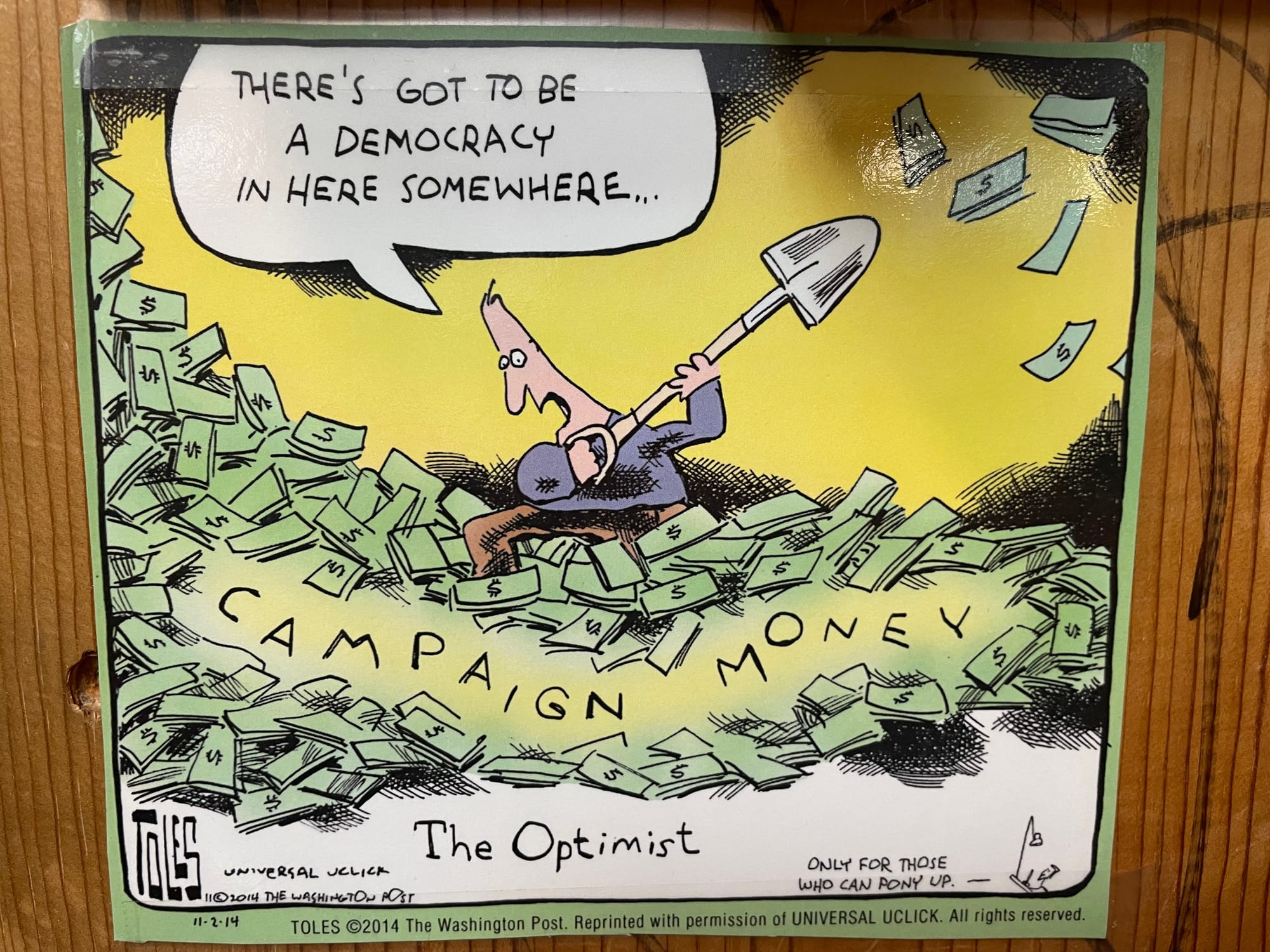
Some of us might flinch at Bernie’s criticism of the Democratic party. But it is certainly true that corporations and billionaires have influenced Democrats in ways that distracted some politicians from focusing on the needs of regular folk versus the very rich. And that has certainly contributed to the growing discontent that helped Trump gain power not once but twice. The feeling that politicians answer to the wealthy rather than their constituents also serves as a reminder of the importance of getting dark money out of politics. Fortunately, you can do something right here, right now: https://mopnm.org/.
One criticism I’ve heard of Bernie Sanders is that his focus on economic inequality causes him to lose sight of the ongoing importance of racism. Ending oligarchy is not going to lead automatically to racial equality. White families in America have 6.3 times the wealth of Black families, or $285,000 compared to $44,900 for Black families (https://wealthvieu.com/personal-finance/net-worth/wealth-by-race/). Shifting money from the billionaire class downward is vital, but if the wealth is spread evenly, the wealth gap will be maintained. Strong economic policies must, of course, be combined with strong policies to address systemic racism. A big part of that is our criminal injustice system, about which I will write in a future blog.
In any case, if you’re too tired to read a bigger and denser book, I recommend spending a few hours with Bernie thinking about how to fight oligarchy.