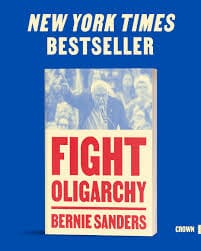
A review of Bernie Sanders' book Fight Oligarchy (Crown Publishing, NY, 2025).
A few days ago, a message from Bernie Sanders arrived in my inbox, offering a copy of his new book in exchange for a donation of any size. Happily, I chipped in to support the nationwide tour he began early in the Trump administration to call out the billionaire class.
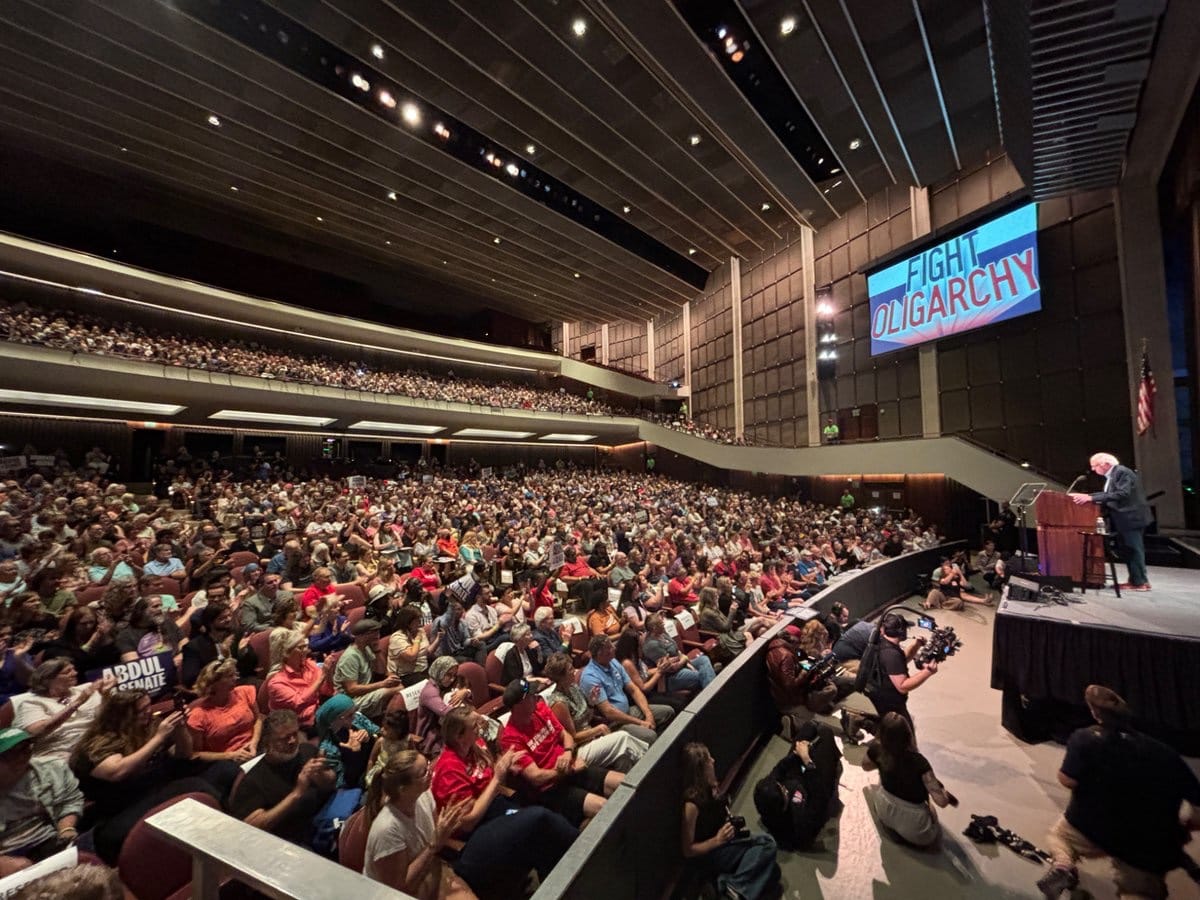
Targeting mainly Republican strongholds, the Vermont Senator (often accompanied by New York Congresswoman Alexandria Ocasio-Cortez) drew overflow crowds everywhere he went: 30,000 in rural Folsom, California, 23,000 in Tucson, Arizona, 9,000 in Warren, Michigan (where Donald Trump had drawn less than half that number during his presidential run).
When he began stumping, Sanders was warned that ordinary people wouldn’t understand the term oligarchy. “I disagree,” the Senator says. “The overwhelming majority of Americans instinctively know, based on their daily struggles, that we live in a country today of supreme inequality—and that our economy and politics have been stolen by the billionaire class.”
Sanders points out that this billionaire class, consisting of a few thousand fabulously wealthy individuals scattered through countries like Qatar, Saudi Arabia, Brunei and Russia as well as in Western empires like the U.S., controls most of the world’s resources. Together they form a global brotherhood devoid of any loyalty to their own nations or peoples—the majority of whom live in poverty— but dedicated instead to their own mutual self-enrichment.
“Oligarchy is a system in which a small number of extremely wealthy individuals control the economic, political, and media life of a nation” This is the order that prevails here at home and increasingly around the world. In the U.S., a handful of conglomerates own the newspapers, radio stations, movie studios and TV networks, along with much of the internet, controlling most of what we read, see and hear. Another half dozen companies control most of the world’s food supply and the same consolidation holds true in other sectors of the economy like tech and finance. In the recent 2024 elections, a small network of one hundred families spent more than $2.6 billion to influence (or buy) the outcome. Under oligarchy, the ultra-rich set the rules. Business interests regulate and control the government rather than the other way around.
Is it any wonder that over half of all Americans under this regime live paycheck to paycheck, worried that one doctor’s bill could send them into the ranks of the 800,000 homeless wandering our streets or sleeping in their cars? That life expectancies—at least for ordinary people—are diminishing? That despite all the cell phones and gadgets of the last half century, a majority of citizens tell pollsters they believe life was better fifty years ago than it is today? In the richest country in the world, for decades the wealth has flowed ever upward, leaving most people just struggling to survive.
Out of desperation, many of these same citizens voted for Donald Trump, who promised to bring back jobs and make groceries more affordable, and who offered convenient scapegoats to explain America’s declining standard of living. (Immigrants are stealing our jobs and driving down wages.) At his inauguration, President Trump was flanked by three of the world’s richest men—Jeff Bezos, Elon Musk, and Mark Zuckerberg. Why? Because billionaires love dictators. Authoritarian rule is simpler and cheaper to manage than trying to reign over a democracy.
Yet many of these same voters, Sanders contends, pulled the lever for Trump because they felt abandoned by the Democratic Party, whose donors spent millions trying to defeat the upstart campaign of Zohran Mamdani, the socialist recently elected mayor of New York City. And in the Fighting Oligarchy tour where he is recruiting a new generation of leadership to run for public office, Senator Sanders says that almost half of the 7,000 first time candidates he has lined up aspiring to be elected to school boards, city councils and state legislatures are doing so as Independents rather than under the label of either major party.
Sanders has a slate of policy proposals to level the playing field, from taxing the rich to Medicare for All. But achieving any of it will require a surge of citizen activists demanding change from their elected leaders. That’s why he encourages readers who aren’t ready to run for office themselves to get involved with grassroots movements like Indivisible and 50501. Democracy, he reminds us, is not a spectator sport.
Bernie is one of the rare politicians in America who cannot be bought. He was the mayor of Burlington, Vermont, just before my family and I moved there in 1989. He was a neighbor, living in a modest home just a few blocks from my own, and after he was elected to Congress he had an office downtown, parking his car in the lot behind the old brick church where I was serving as minister at that time. He doesn’t do spin or focus groups. He has been preaching the same message these many years, fighting for America’s working class.
Unfortunately, the special offer to get a book for one dollar or whatever you can afford has expired. But Fight Oligarchy is still available from Amazon or better yet, your local bookshop.
 Crown
Crown
Get it. Read it. And get organized.