Although I'm now back in the States, with all the inherent insanity, here's my second and final post from my winter trip back to my previous home, Dhaka Bangladesh.
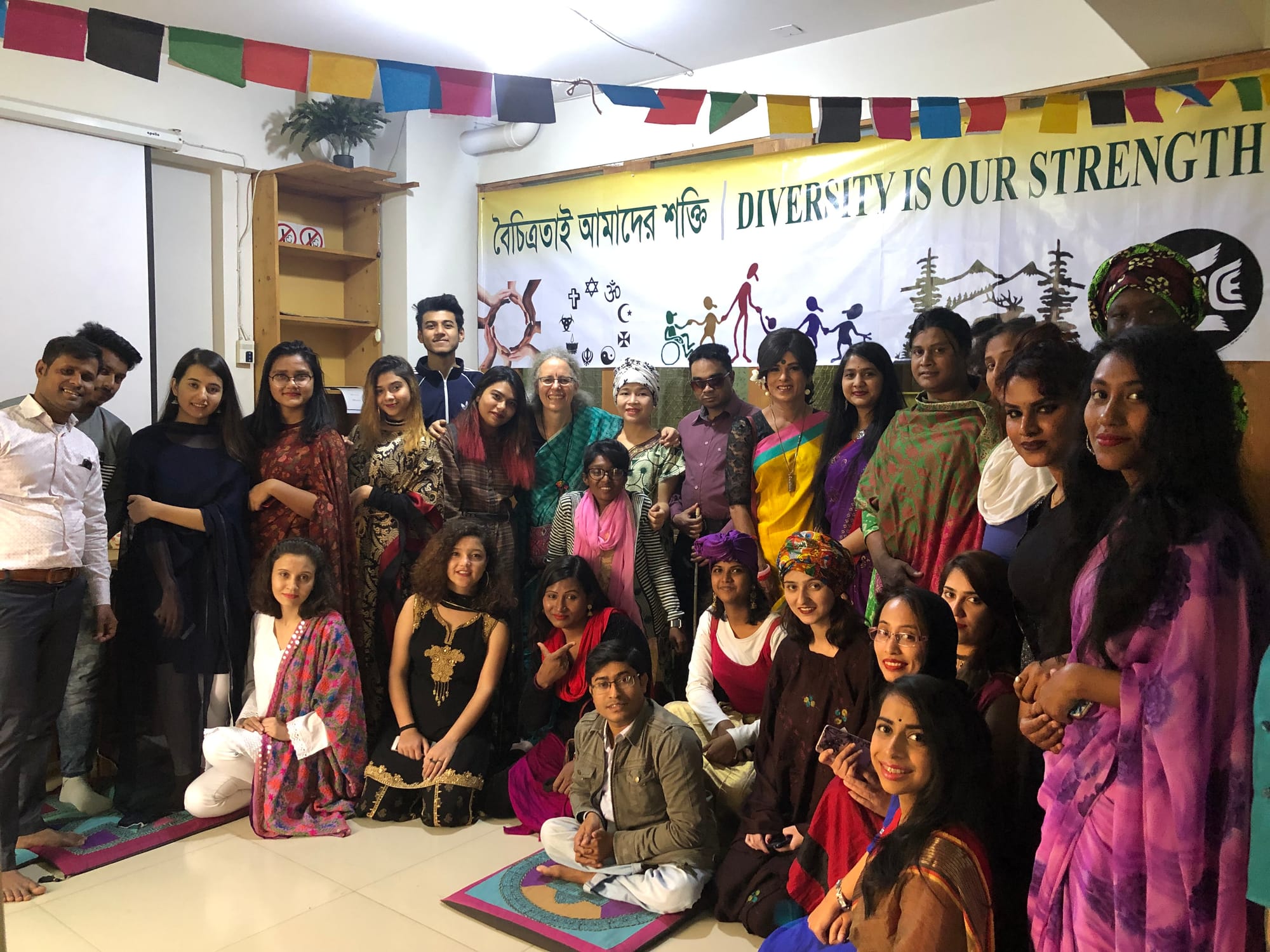
During the last decade of my life in Dhaka, my favorite activity has been interacting with interns from the Asian University for Women (AUW), located in Chittagong, Bangladesh. The Institute of Wellbeing, which I co-founded, accepts large groups of interns from AUW a few times a year. We try to help them expand their thinking on a number of issues and gain some practical advocacy skills. The women are generally bright, creative, and fun. It’s a treat to be around a mix of nationalities, drawing as the university does from a number of Asian countries.
One memorable evening during this stay in Dhaka, I spent two and a half hours mostly listening, in succession, to three young Afghan interns. They are, as a friend later points out to me, among the lucky ones: they are out of Afghanistan, safe, and studying at a reputable university. There are people assigned to help them get into a Masters’ program in another country. All that said, their lives are by no means easy.
In jumbled fashion, here’s a brief summary. One of them was admitted to an Australian university and had sponsors, including a free place to live. Only later did she discover that Australia is not issuing student or tourist visas to Afghans. Another has extensive contacts in the US, and for years had planned to study there; now she must start over, since as an Afghan she is no longer welcome here. The third woman’s mother is in the US but doesn’t leave her home. She is depressed because she desperately wants her daughter, who happens to be the youngest child, to join her there. “Well, who knows, in three years’ time…” I try to say, realizing how desperate I sound.
One of these young women left home at age nine to live with her sister-in-law and essentially raised, single-handedly, her nieces and nephews. Her mother, who she barely knows, wants her to return to Afghanistan and live with her. “Please don’t throw away your education,” I find myself saying. She assures me that she has no intention of doing so. “I want to become rich,” she adds. Later she explains: she is the only one among her siblings (mostly boys) to study at university. Life is hard for them back in Afghanistan. She wants to earn a lot of money so that she can send it back to them. She clearly loves children. In the past she had hobbies she was passionate about. But she plans never to marry, never to indulge her desired profession, but rather to focus simply on earning money to make life easier for her family back home.
I’ve had a lot of Afghan interns in the past. There are currently more than 500 Afghan women studying at AUW. AUW’s founder arranged the evacuation of a large number of then-current students when the Taliban took over and continues to help young Afghan women get to Bangladesh, and then a third country, so they can study. I’ve seen many of them do well, but I have also seen the struggles they face. When their undergraduate degree is over, they have to find a place to go; they are not welcome in Bangladesh longer-term, can never gain legal status in Bangladesh. Other Asian countries also do not want them. Most of the Afghan women I meet are from a minority group that is in particular danger in Afghanistan. Even when they do succeed in gaining asylum in Europe or North America, they face all the struggles of new immigrants.
As I’m slowly sinking under the weight of their stories, one of them casually mentions that she wants to do her thesis on the educational struggles of Rohingya refugees in Bangladesh. “At least we can get out of this country,” she comments. “They have nowhere to go.”
It is hard to listen to all they suffer, but their youthful optimism is contagious. They dream of being reunited with their families, knowing how uncertain that is and how long it could take. They are frightened of the future, but their current security, knowing that there are people and resources to support them, is reflected in their words. I only wish that these women were not exceptional for the fact of having safety and opportunities, and that our government would realize the wisdom of allowing more of these hard-working, dedicated, and determined people to make their homes here.