"History doesn’t repeat itself, but it often rhymes." Mark Twain
Many of us who are repulsed by Donald Trump feel we are living in unprecedented times, marked by assaults on press freedom, by senseless and unpopular wars, by armed troops murdering U.S. civilians, by resurgent racism and xenophobia, and by a government surveilling and suspicious of its own people who are simply trying to exercise their Constitutional rights. The attack on democratic institutions feels unparalleled.
But America has seen much of it before. In 1917, Woodrow Wilson was inaugurated to his second term as President, swept to victory on the campaign slogan that “He Kept Us Out of War.” Within a year, America was sending troops to Europe to fight in the trenches of what was up until then the bloodiest, most brutal and least necessary conflict in global history.
At home, dozens of newspapers were shut down and ceased publication for daring to criticize the war effort. Under the Espionage Act of 1918 and the Sedition Act of the following year, any “disloyal, profane, scurrilous, or abusive language" critical of the government, the flag or the Constitution became a criminal offense, punishable by up to 20 years in prison. The penalty was no empty threat. Eugene Debs, founder of the Socialist Party of America, who had run for the Presidency against Wilson, was given a ten year sentence for distributing literature opposing the draft and sent to a federal penitentiary in Moundsville, West Virginia. He received a million votes running for President once more from his jail cell the next year. But the laws would not allow a genuine opposition party to emerge.
In the United States, this was an era of expansive growth for the Ku Klux Klan and, in the town where I grew up, it saw the massacre of hundreds of African Americans in the notorious Tulsa Race Riot. It was the age of the Battle of Blair Mountain, the largest domestic uprising since the Civil War, when thousands of coal miners demanding better pay, led by John Lewis and Mother Jones, were put down by Presidential order, with Army and National Guard troops deploying aerial bombers and poison gas left over from the battlefields of Europe against the strikers. It was the heyday of the eugenics movement, when “the better races” claimed a scientific basis for white supremacy. It was the age of Teapot Dome, one of the biggest government graft games ever, involving pay-offs from Big Oil to drill into publicly owned petroleum reserves. It was the scene of glitter and deprivation sketched by F. Scott Fitzgerald in The Great Gatsby, a period of massive wealth inequality, where the ultra-rich partied in a cocoon of privilege while economic mobility for ordinary Americans stagnated.
Does any of this sound familiar?
History doesn’t repeat itself, but can anything be learned from past experience? How did America survive and emerge as a functioning democracy from a ghastly and repressive epoch so similar to our own?
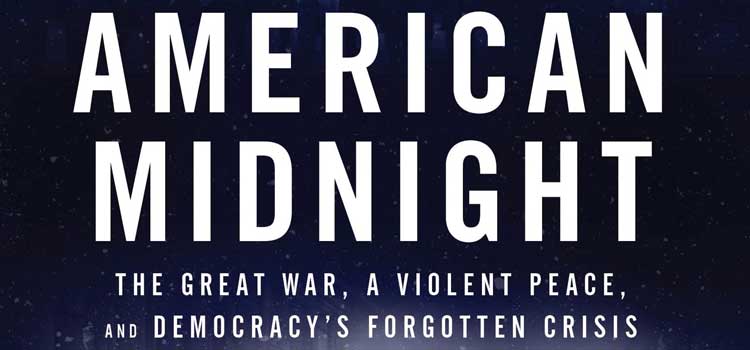
Stay tuned for answers when Donovan Kolbly and I interview Adam Hochschild on Indivisible Santa Fe Radio. Hochschild is the author of American Midnight: The Great War, a Violent Peace, and Democracy’s Forgotten Crisis (Mariner Books, 2022), listed as a best book of the year by the New York Times, Washington Post, New Yorker, Chicago Tribune, and Kirkus.
Hochschild, a renowned journalist, delivers a harrowing portrait of America in 1917-21, rife with racist violence, xenophobia and political repression abetted by the federal government. The book serves as a cautionary tale and a provocative counterpoint to our own era. (Editor’s Choice, New Y ork Times, October 13, 2022)
Some questions I want to ask Mr. Hochschild:
What can our great grandparents' generation teach us about the fragility of our liberties and how to preserve them in times like these?
From your study of history, why do democracies descend into authoritarianism? What does our past tell us about the most effective forms of resistance?
You say, Mr. Hochschild, that you are "a big admirer of Indivisible." What in particular about our organization do you find inspiring?
I read American Midnight soon after its publication and now look forward to perusing it again before our interview with the author. Donovan and I expect to record and release our podcast in the next two or three weeks. I hope you'll want to listen in.